Monday, 5 May 2014

Link Roundup 5th May 2014

Happy May Day bank holiday! I hope everyone is enjoying a well earned break from work today. While you relax, here's my selection of interesting links from around the internet for your viewing pleasure.
  1. The VC at Cambridge has been talking about scientific publishing and how he's not very happy with the amount the university are spending with scientific publishing giant Elsevier. In addition he's also been talking about how easy it would be to go open access, in view of the large number of journals which charge for publishing and whether pushing to publish in free open access journals would hurt a researcher's career prospects. I think this is a really interesting debate as a lot of the research with the most impact is either published behind a pay wall, or open access at a rather large expense to the university. Going forward there is no doubt that the free open access vs. paid open access vs. subscription debate is going to be rattling on for a long time.
  2. I came across this interesting article via Athene Donald's twitter feed and it's definitely an interesting read for any aspiring/current PhD students. There's definitely a few things in there that I for one really need to remember! 
  3. As well as talking about the lack of women in science, shouldn't we also be talking about the lack of men in nursing, teaching and other caring professions? I would definitely say yes! Equality is a two way street; men need to feel welcome and be encouraged into the more 'care focussed' professions just as much as women should be encouraged and accepted into 'technical' careers. This interesting article provides a spot light onto the disparities in the number of men and women in different profession and wonders if we need a pipeline into the caring professions for men, just like the one being put into place to help women into science and technology. Thank you to the Women In Science, Engineering and Technology Group at the University of Leeds for dropping this into my inbox this week.
  4. After recent controversies in stem cell research, I came across some good news for the field this week! A team of researchers have cloned skin cells into a donated egg to create insulin producing cells as a possible future cure for diabetes. This form of creating stem cells, while being bundled up in ethical issues, allows for the production of stem cells without genetic reprogramming, which will hopefully avoid the produced cells  being a cancer risk. Fingers crossed this could be a step in the right direction for research into stem cell production.

Monday, 28 April 2014

How did I find physics?

I suppose my story starts with the most cliché influence a physicist could have. Star Trek. One afternoon my parents sat me down to watch the Voyage Home filled with whales and nuclear wessles and that was it. That evening I started watching Voyager (when it was back on BBC2 ) and thus began the three appointments a week I had with the crews of the Enterprise, Deep Space 9 and Voyager. Needless to say, I began to really think about whether there was life on other planets, what could nanotechnology do and what was real space travel like. Luckily my parents were more than happy to facilitate my interest in science and trips to the science museum, nuclear power stations, nuclear bunkers I suppose in many ways my continued fascination with space and all things nuclear spurred me on to do triple science at GCSE so I could (hopefully) study science in a bit more detail. 

However, when I started my GCSEs I'd had another 2 influences actting on my life; the internet and the Lord of the Rings. The combined effect was that I thought I wanted to go into computer science and specialise in computer generated graphics for games and films which was further fuelled by the contrast between my not so good physics teacher (I did a lot of sticking the syllabus into my book over those two years) and my fantastic IT teacher. However, things began to change when I saw a documentary on BBC4, Dr. Michio Kaku's Time (currently available on youtube here). Time was a revelation, it introduced me to the ideas of general relativity and told me that time travel and worm hole's might just be possible within the theoretical limits of the universe. What more would you need to hear to inspire a Whovian or Trekkie to give physics another look? Soon after Time aired I prepared for my end of year 10 exams, and suddenly realised from reading the text book the material I had been taught in physics classes was actually interesting. It described how things moved and how we powered our homes along with so many other things. And I wanted to explore and find out more. I wanted to know how nuclear fission worked, I wanted to know why cells keep us alive, I wanted to know more about the atom. So it became obvious, I needed to do A-level physics. Don't get me wrong I still loved IT and originally thought I'd do A-level computing too, but in the end I was guided into further maths with promises of improved chances of entry to Computer Science at university.

I'm happy to say it was the right choice. At college I had 2 fantastic physics teachers who not only made sure we learnt the material, but also gave us the feeling of how wonderful it was to use physics to describe the world. But I still had my eye on what I wanted to do after university. Should I do engineering, should I do computer science or should I do physics? The more I read, the more I realised that doing physics wouldn't box me in like computer science or engineering might, it would leave my options open. I don't know exactly when I decided, but I came to the conclusion that physics was the subject for me. It was during my UCAS prep that I really began to fall in love with physics. I read 'In Search of Schrödinger’s Cat' by John Gribbin, I attempted to read 'The Road to Reality' by Roger Penrose which was mostly over my head but introduced me to some really cool concepts in cosmology and I devoured QED by Richard Feynman. These books showed me that you didn't have to look into deep space to find the extraordinary; the extraordinary was around us every day. We live in a crazy quantum world filled with beauty and contradiction and I needed to understand it. 

The rest, as they say, is history. I applied to universities with strong focusses on quantum technologies and nanotechnology, got my degree and as I write this, I'm sitting at a desk in the experimental quantum information office. It was a long road to get here, but I found my way in time. I suppose it’s true that inspiration can be found in the strangest of places, so always keep an open mind and you never know where you may end up!

Monday, 21 April 2014

Weekly Round-Up 21st April 2014

It may be a bank holiday, but its still a Monday, so its time for a bank holiday round-up of things that have caught my eye over the past week.
  1. Europe's Sentinel Satellite Has Begun to Produce Images
    The European Space Agency's first satellite of the Sentinel project has beamed its first pictures back to earth. This marks the start of the project to provide detailed Earth observation of things as diverse as sea ice, oil spills and forests across the world. It's extremely exciting to see the ESA heading up this project and I hope it is a huge success.
  2. Stem Cell Misconduct
    On a less inspiring note it has been reported that Haruko Obokata, the author of a seemingly ground breaking paper showing an easy method to make adult stem cells behave more like 'true' stem cells, has been found guilty of misconduct by her home institution. Obokata maintains that the underlying science of the paper is still sound, but at time of writing no external researcher has replicated the results of the paper.
  3. The LHC Finds a New Form of Matter
    On a more positive note on 9th April CERN announced that the LHCb experiment had found a new form of matter, the Z(4430) particle. Z(4430), which has been predicted, observed and disputed, has been measured by the LHC in a paper available on the archive here (warning, not for the faint hearted!). The race is now on to determine is Z(4430) is the previously predicted tetraquark, a postulated particle formed of 4 quarks (where quarks are the building blocks of protons and neutrons).
  4. Kepler Finds New Earth-like Planet
    Finally, we have some great news! NASAs space telescope Kepler has spied a new planet around the size of Earth orbiting a star in the Goldilocks region, described as an earth cousin. This means the planet is not too hot or not too cold, so it could have water present on the surface. While the orbit of the planet doesn't automatically mean that we will find life there it's the first recorded Earth cousin and hopefully we'll find an earth twin sometime soon.
And finally, as a follow up to floppy disc drives playing Tainted Love, I give you The Doctor Who Theme on 8 Floppy Drives. Enjoy!

Monday, 14 April 2014

Odds and Ends

Unfortunately, it’s a short-ish post from me today as things have been a bit on the hectic side. I don't have a big Easter holiday on the horizon so it's PhD business as usual for me! At the moment I have lots of different things that are demanding my time and attention which, while important, don’t do much to advance my project on the surface.

Firstly, conference season is on the way, so abstracts (short summaries of your work) need to be written, posters produced, presentations practised and travel arrangements made. I've been lucky enough to have an abstract accepted as a talk at a conference this summer and while I'm not writing my presentation for it just yet, it’s in Italy, so  there are lots of things for me to sort out before I even get started. I need to register for the conference before the price goes up (check), make sure I have my travel documents in order (nope), book flights (nope), transfers (nope) and a hotel (nope). All easier said than done when you have to claim everything back on expenses.

I'm also preparing a presentation to give to my physics research group in Leeds. I'm actually quite nervous about it as I've not had to present to a physics audience before. So, that means I'm well practised in skimming over the detail of the mechanisms that under pin my work and I know that this is what the other physicists will be really interested in. Even if it doesn't work out it’ll give me a trail run for the future, but if possible I’d much rather not crash and burn.

As much as I try not to, part of my brain is tied up playing the waiting game, something which I'm not very good at. I've currently got a paper on submission to a journal and I've submitted an abstract for another conference. When it comes to the abstract I should know before the end of the month if it has been accepted, but it could be a while before I hear anything back from the journal. Apparently 3 months is considered a quick turn around and I'm just reaching a month in, so I've got a while to wait yet. The worst thing about it is the uncertainty, there's no standard information system for journals so they can tell you as much or as little as they want about how your submission is progressing. I know I should just let it go and not think about it, but it’s really hard not to look for news when I'm checking my e-mail on a morning.

Finally, alongside these 'side' bits there is some ‘real’ work for me to do. I'm currently coding a program to help me process data more quickly than my current manual methods. I'm really enjoying this bit as I'm learning to use python and although it can be frustrating at times I really like coding and I get a real sense of achievement out of it.

It seems that sometimes in a PhD you have to be a bit of a juggler, keeping lots of balls in the air whilst on a unicycle (at least that's what it feels like). On the upside, it looks like I should be able to confidently say I have ‘good time management’ and ‘multitasking skills’ on my CV at the end of it all!

My advice on how to keep everything going? Don't think about it too much, make to-do lists for each week (I find I don't stick to daily ones) and ask for help sooner rather than later!


Monday, 7 April 2014

Link Round-up 7th April 2014

Here's my this weeks round-up of things on the net that have caught my eye:

  1. It seems like science fiction my soon become science fact as the FDA approve the first human trials of cryopreservation. In the trial 10 patients with serious knife or gunshot wounds will be placed in suspended animation, hanging between life and death, in an attempt to create more time for doctors to save their lives. This incredible technology has been previously trialled successfully in pigs and, if successful, could revolutionise surgical treatment. 
  2. It's a little known fact that scientists can been seen in all areas of public life as directors, sports people, actors and musicians. This article in the guardian highlights some famous faces with strong scientific acumen who left the lab for pastures new.
  3. Scientists at NASA have captured a solar flare in ultraviolet light on the 2nd April. It's been re-colourised and uploaded to youtube so everyone can watch this incredible phenomenon.
And finally, it's a week of new beginnings as Game of Thrones returns, filming on Star Wars Episode VII has begun and the second series of The Musketeers goes into production for BBC 1 today. But what should you do while waiting a full year to get season 4 of Game of Thrones on DVD (come on HBO, a year? no wonder its the most pirated show ever)? Or to help beat the no Musketeer's blues? Watch Radio 1's Game of Moans and Wolverine the Musical of course. Then go see Captain America: The Winter Soldier, because its awesome!

Monday, 31 March 2014

How do you find a PhD place?

Following my last blog on why you might do a PhD and with final exams season approaching I thought I'd talk about how you go about finding a PhD place to apply for. Once again, I must say I'm focusing on science PhDs, because yeah...I'm a sciencey person.

What routes can you go through to find a PhD? In my experience there are 4 main ways to go:
  1. Apply to a relatively new centre for doctoral training (CDT).
  2. Apply for an advertised position.
  3. Accept a position offered by a current or past supervisor.
  4. Propose a project and find a supervisor willing to take you on.
No matter whichever way you find a PhD through there is one thing you will need to complete your studies, money! Money to live on, money to pay your tuition fees and money to fund your actual research. If you apply for a CDT funding will be guaranteed, so you can apply safe in the knowledge you will be paid and have all your study expenses covered. Similarly, if a position is advertised online or in a university department, it will almost certainly have funding attached to it. Things start to get a little bit more uncertain if a current or past supervisor offers you a position, they may have funding and be offering you first dibs on the place, or they may have a project in mind, but no funding sorted out. Therefore, you may have to wait a while until funding is secured before you can sign on the dotted line. However, if they have a project and want you to do it then it's likely they will do everything they can to secure you funding. The most difficult situation to be in is when you propose your own project. In that situation you will have to secure your own funding by applying to research councils, charities or universities with a detailed project proposal. 

Where do you go to find out about advertised positions and CDTs? My personal favourite website is Find a PhD. Find a PhD lists a huge range of funded and unfunded projects, along with funding opportunities across pretty much any field you care to name. It's basically a one stop shop for PhDs. My advice is to make sure you pay attention to the adverts on the side of the page as well as the search results as that's where I found a link to the PhD I eventually applied for and got. Another way to go is through prospects.ac.uk. They also provide UK wide listings for taught and research positions along side their graduate job listings. The final place to look is on the individual websites of university departments. Look up the webpage for the department you're interested in and check their postgraduate, research and research group pages as all the available PhDs can be spread across these locations. 

Each PhD route has its own advantages and disadvantages and may suit some people better than others. A place in a CDT entails signing up for a 4 year course in a research field. Unlike every other option, in a CDT you don't commit yourself to a project straight away, you spend a year learning and gaining new skills during which you choose a research project. This has the advantage of allowing you to investigate supervisors and projects in detail before you commit to one. Further to this there is lots of wriggle room to propose a project within the CDT's field and, as you already have funding, supervisors are happy to negotiate project modifications (which I did) or complete overhauls. Over 5 years most CDTs ultimately recruit 50 students. Therefore, being part of a CDT means you'll also be part of a community of students all on the same program. The main disadvantage is the vast amount of requirements you have to meet. All PhDs have things you have to do outside your research, but in my experience CDTs have anywhere between 3 and 4 times as many things you're expected to do. This is fine and actually helpful in first year, but once you begin your research it can sometimes be frustrating as you have many other things you would rather and should rather be spending your time on. 

In contrast to a CDT, if you apply for an advertised position you sign up to do a specific project with a specific supervisor for around 3 years straight away. The good thing about it is that you know exactly what you'll be doing from day one allowing you to be very focused. However, you can end up committing to working with someone you've never met before on something you've not studied before. Therefore, if you don't fully understand what you're getting into, there is potential for problems to crop up later down the line

Accepting an offered position from a current or past supervisor can work out really well. You'll be working with someone you know and hopefully will have a good idea if you can get on with them for 3 years. You'll probably also be doing a project that is similar to what you've done before so you'll hopefully be confident that you'll like the work involved in the project. However, going down this route can lead to you missing out on the opportunities that are available elsewhere for something safe.

Finally, if you propose your own project you're fully able to set your own boundaries. So hopefully you will love what you do. However, you have to find a supervisor to work with which might be easier said than done if you don't have funding sorted out. Additionally, as you proposed the project your supervisor might not be fully engaged with it, or fully understand all aspects, which could impact on the quality of the supervision you receive.

Whatever route you choose the most important thing to do is ask questions before you apply. CDTs often have open days you can attend to talk to the head of the program, potential supervisors and students about the work you might be doing. For non-CDTs, speaking to the supervisor about the project they're offering is vital, you'll get useful information that you can use at interview and also might find out key details the advert missed out. In all cases, if possible, talk to current students. Ask them about their experiences with the program, work and supervisor. E-mailing the administration office is the best way to find someone to talk to as the admin staff should be able to point you to someone with roughly the same background in the group you're looking at who'll be happy to chat to you.

Do you have any questions about applying for PhDs? Or, what are your experiences of applying for a PhD and what was the best advice you received? Why not share in the comments below!

Monday, 24 March 2014

Link Round-up 24th March 2014

This week has been pretty big in science so here are my favourite links from the past week:
  1. Gravitational Waves Exist!
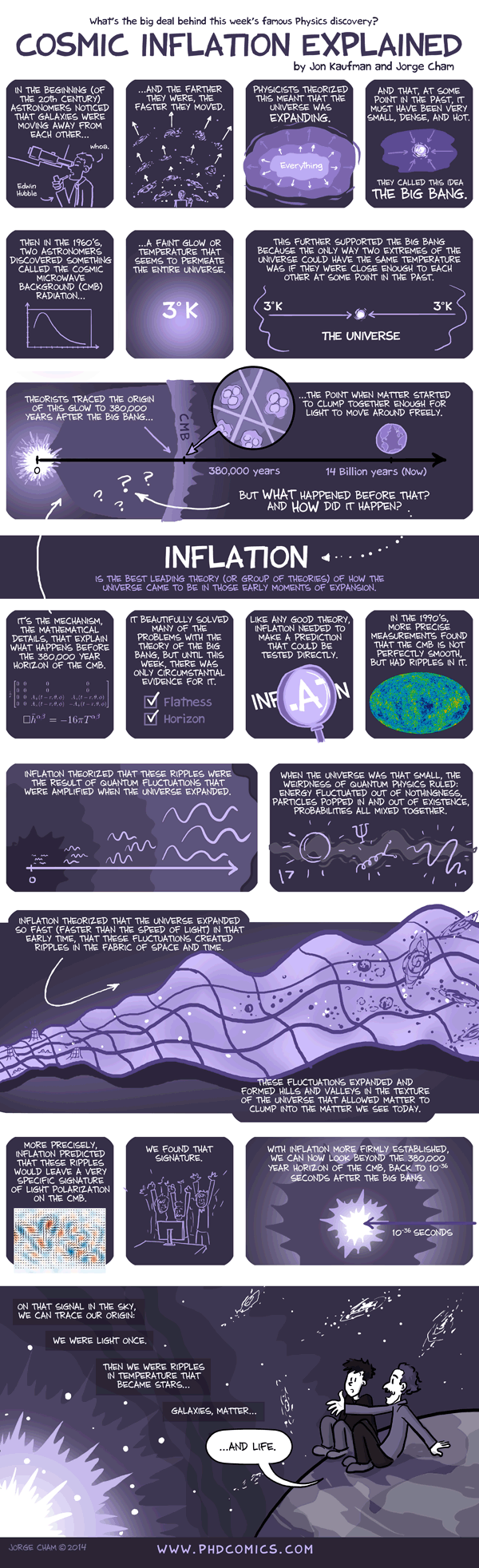
    Last week a paper was published describing the first every observation of gravity waves! The BBC have provided a very handy guide to what it all means. I'm not even going to try to start explaining it here as this is very, very much out of my field. However, the headline discoveries are that at the beginning of the universe everything was light and the initial expansion of the universe was faster than the speed of light. (Thank you PhD comics for explaining that to me!) 
  2. What impact does the Higgs Boson have on society?
    I was at an event this week and was pretty shocked when a scientist said the following. "What impact does the Higgs boson have?" where he was basically saying "what benefit does it have to wider society?" So I have been spurred on to link up to firstly the CERN technology portfolio which provides details on the various technologies developed by CERN and a more thorough document describing the direct impact of the LHC for the very interested. As I think basic science research is very important I may well expand on this topic in a future blog post.
  3. Planet Hunter's has new data for you!
    Planet Hunter's is a citizen science project from zooniverse which gets people from all over the world to search for new planets by looking at the light from stars in distant galaxies. They've finished classifying their first batch of data (quarter 14) and they now have a brand new set to get stuck into. Maybe you can help find a brand new planet!
  4. The Thesis Whisperer
    The Thesis Whisper is a fantastic blog for anyone who's doing or thinking of doing a PhD. It's full of great tips for writing and research in general that I have found really helpful over the past year.  
And finally... Here's my favourite cover by the Piano Guys, Cello Wars its a fantastic treat to both listen to an watch. Also, after being blown away by The Lego Movie this weekend I have to link to the theme song, the epic Everything is Awesome.